

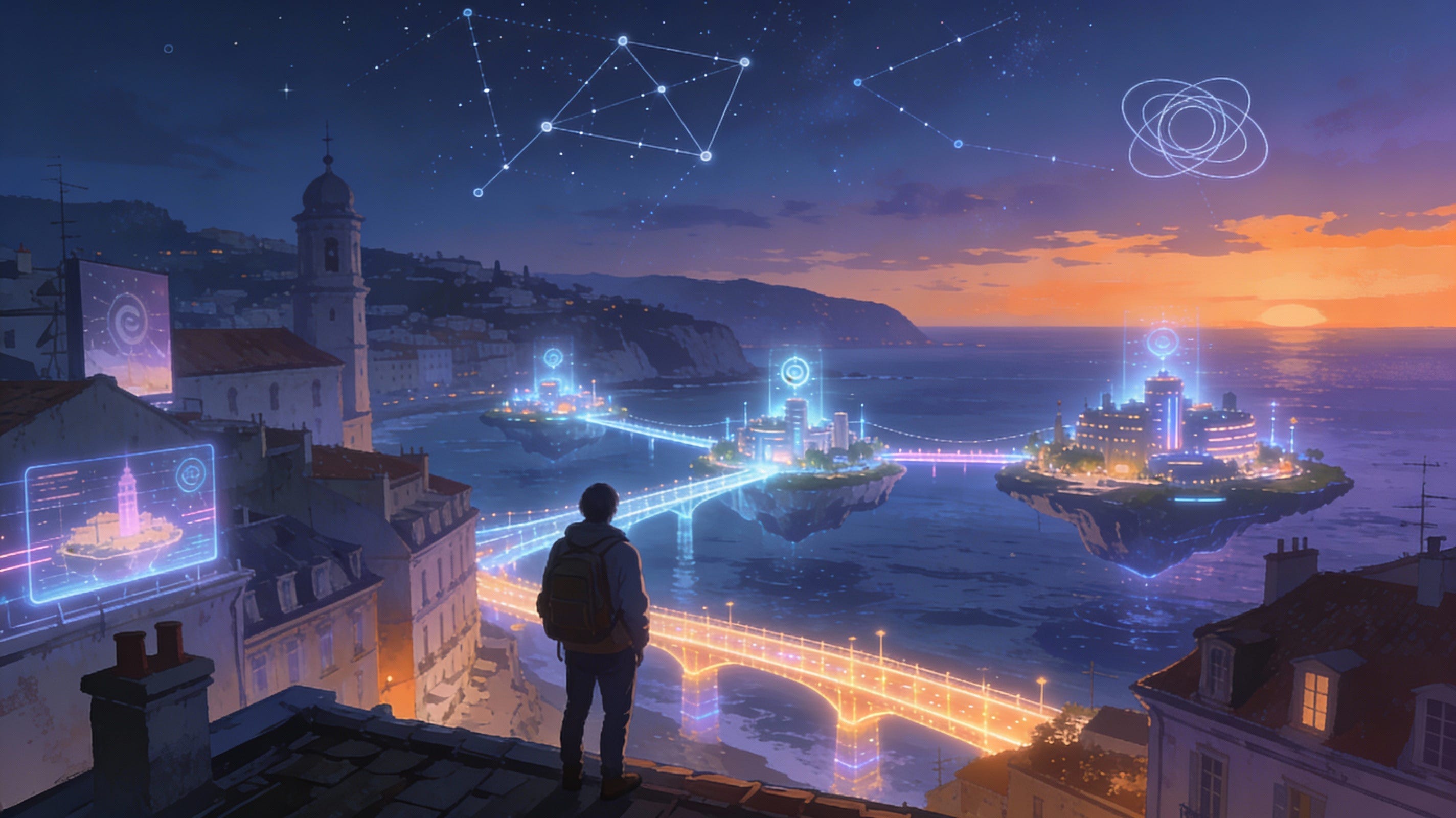
2025 felt like living in fast‑forward while the world itself was quietly splitting into parallel realities. Social feeds became outrage machines, markets matured and ossified at the same time, and new political and economic experiments moved from theory to MVP. Meanwhile, between building at LayerX, scaling TAIKAI hackathons, attending crypto conferences and going down the network states rabbit hole, it became clear that the old mental models are breaking.
This is a reflection on 7 lessons from 2025 and how they shape the future to build toward in 2026.
Lesson 1: Fragmented Reality, Weaponized Feeds
The first realization: the world is not just polarized, it is sharded. Social media is no longer a public square; it is a set of overlapping war rooms optimized for escalation, not understanding.
In 2025, every macro event (wars, elections, regulation, AI news, crypto drama) was instantly reframed into narratives of “us vs them” inside tightly sealed echo chambers. This fragmentation is not only ideological; it is informational and emotional, and it shapes how people invest, vote, migrate, and build.
For 2026, this means:
Treating information diets like health: what you consume defines your emotional and strategic bandwidth.
Being intentional about which “tribes” you subscribe to, because each one comes with its own truth, its own enemies, and its own blind spots.
Designing products and communities that reduce performative outrage and reward contribution, not just attention.
Taking more time off screen: enjoy more IRL stuff, read more books and articles and less social media clickbait.
Lesson 2: Institutional Crypto vs Cypherpunk DNA
Crypto in 2025 felt like watching your rebellious teenage cousin show up to a family dinner in a Armani suit. ETFs, RWA platforms, custody services, compliant infrastructure, and the presence of big institutions made the market feel both safer and less wild.
On one hand, this institutionalization is exactly what mass adoption needed: better rails, more liquidity, and products that normal people and enterprises can actually use. On the other hand, it raises uncomfortable questions: if everything important is mediated by regulated custodians, ETF providers, and compliant gateways, what is left of the original cypherpunk ethos of self‑sovereignty and censorship resistance?
Going into 2026, the only sane approach is to:
Accept that “crypto for everyone” necessarily looks different from “crypto for cypherpunks”.
Build dual‑stack systems: a regulated, UX‑friendly surface plus an opt‑out, self‑custodial, permissionless core.
Make sure that while institutions come in through the front door, the exit to sovereignty is never bricked over.
Lesson 3: Network States Move From Meme To Prototype
The third lesson: network states stopped being just a Balaji meme and started feeling like a coordinate system for a lot of frustrated people.
As 2025 rolled on, the pressure points in legacy nation states became more obvious:
Immigration that is simultaneously over‑regulated and under‑managed.
Currency debasement and debt spirals eroding savings and trust.
Global conflicts making geopolitical risk feel closer to home.
EU‑style regulatory overreach (chat control proposals, heavy AI regulation, strangled capital markets) pushing builders and capital elsewhere.
Against this backdrop, the rise of communities like network states, charter cities, pop‑up cities, and crypto‑native enclaves started to look less like sci‑fi and more like an early‑stage category. The gatherings, offsites, and city‑curious communities I plugged into this year were not just events; they were reconnaissance missions for alternative governance and new forms of citizenship.
For 2026, the move is:
Treat network states less as ideology and more as infrastructure: land, law, capital, culture, and code.
Use hackathons, residencies, pop‑cities and pop‑up events as “soft power” sandboxes for these future jurisdictions.
Help founders and communities prototype governance, not just products.
Start organizing concrete experiments like pop‑city initiatives in Portugal (and the EU in general) and supporting existing ones in other places like Infinite Games by Infinita City, where builders, citizens and misfits can rehearse new ways of living, working, and governing together.
Lesson 4: Privacy Is No Longer A Niche, Especially For Money
Another clear pattern: the window where financial privacy was a nerdy, optional topic is closing. Surveillance rails are becoming the default, from CBDC experiments to increasingly invasive AML regimes and data‑hungry fintech stacks.
The difference now is that the tech for privacy is finally good enough for real users:
Zero‑knowledge proofs are production‑grade.
Privacy‑preserving stablecoins, wallets, and L2s are moving from research threads into products.
UX for “private by default” systems is improving fast enough that users do not need to understand the math behind them.
In 2026, this unlocks a few non‑negotiables:
Money needs privacy in the same way speech needs encryption; without it, both are performative and easily chilled (especially for all the institutional money coming onchain).
Builders should treat privacy not as an add‑on feature but as a baseline expectation, like HTTPS.
Communities and network states should bake privacy guarantees into their economic fabric from day zero.
Lesson 5: AI Is Eating The World Faster Than Software
In 2011, Marc Andreessen said “software is eating the world.” In 2025, it felt like AI is eating software and the world at the same time.
Two things stood out:
The speed of capability improvement outran the speed of demand formation. New models, agents, copilots, and workflows arrived faster than society could meaningfully absorb them.
The bottleneck shifted from “can this be done?” to “who owns the distribution, the data, and the integration with existing workflows?”
By 2026/2027, an inflection point is likely:
A lot of “AI wrappers” and thin tools will die.
Real value will accrue to those who own:
Distribution (audience, brands, communities).
Data (specialized, proprietary, or context‑rich).
Infrastructure (platforms that other builders depend on).
For someone building in web3 and network states, this fusion is powerful:
AI agents can become economic actors, managing onchain assets, voting, participating in DAOs, and coordinating work.
Hackathons like TAIKAI’s can evolve from “build a demo in a weekend” into “spin up AI‑native micro‑economies and test them live.”
Local events like vibecoding sessions are templates for how AI moves from buzzword to practice inside real communities.
Lesson 6: If Communism Failed, Capitalism Might Be Next
Another uncomfortable question from 2025: if communism clearly failed in practice, what if capitalism, at least in its current form, is also hitting a wall?
Symptoms are everywhere:
Asset inflation and inequality that make “meritocracy” sound like satire to younger generations.
Regulatory moats and rent‑seeking that reward incumbents more than builders.
Externalities (climate, mental health, information quality) priced at near zero.
The lesson is not “burn it all down,” but:
Acknowledge that both central planning and unconstrained capitalism have failure modes that compound at scale.
Start prototyping hybrids: markets plus commons, tokens plus reputation, private ownership plus shared governance.
Use network states, DAOs, co‑ops, and onchain incentive systems as experimental labs for post‑capitalist playbooks.
2026 can be the year where:
Token design, legal structures, and community governance are treated as economic R&D, not side quests.
Builders stop copying Web2 “growth at all costs” and start optimizing for resilience, fairness, and sovereignty.
Lesson 7: Luck > Skill → So Expand Your Luck Surface Area
The final and most humbling lesson: a friend showed me recently how much of your trajectory is explained by luck rather than skill. That realization stings at first but becomes freeing.
The conclusion is simple:
You cannot control luck, but you can increase your luck surface area.
You do that by building a decision making framework that allows you to:
Ship more often.
Meet more interesting people.
Show your work in public (tweets, LinkedIn, events, open‑source).
Stay alive and in the game long enough for compounding to kick in.
Looking back at 2025, most meaningful outcomes came from being present in the right rooms repeatedly rather than from a perfectly optimized plan.
In 2026, the operating system becomes:
Optimize for serendipity: more surfaces where good randomness can hit you.
Reduce “existential risk” in your own life: health, runway, reputation, and legal safety.
Default to action over over‑theorizing; each shipped thing is a new lottery ticket with better odds.
Or, borrowing Bryan Johnson’s framing, the prime directive is simple: don’t die: physically, mentally, or financially, so you can stay in the game long enough for luck, compounding, and infinite games to do their work.
Looking Ahead To 2026: What To Build
Tying all of this together, 2026 looks like a year for deliberate building in a chaotic environment:
In a fragmented world, build bridges and higher‑context communities, not just louder broadcasts.
In institutionalized crypto, defend the escape hatches: self‑custody, openness, composability, and credible neutrality.
In the rise of network states, treat every event, residency, and hackathon as a small‑scale governance experiment.
In the age of AI abundance, focus on owning distribution, data, and infrastructure, not just prompts and wrappers.
In the search for post‑capitalist models, use crypto‑economic design and network states to test new incentive structures in the wild.
And through it all, keep increasing your luck surface area and, most importantly, don’t die and keep pushing.
This is the future 2026 invites: a year where you double down on building tools, cities, and communities that are more sovereign, more private, more humane, and more anti‑fragile than the legacy systems they are quietly replacing.